Get Free Consultation!
We are ready to answer right now! Sign up for a free consultation.
I consent to the processing of personal data and agree with the user agreement and privacy policy

We are ready to answer right now! Sign up for a free consultation.
I consent to the processing of personal data and agree with the user agreement and privacy policy


Delivering full control over cost, schedule, and quality across every stage of construction.
Passive House (Passivhaus) is a high-performance building standard focused on energy efficiency, superior indoor comfort, and affordability. Passive House is not a commercial brand; it is an international construction concept, studied, analyzed, and proven over more than 25 years of experience with over 25,000 buildings constructed to its specifications.
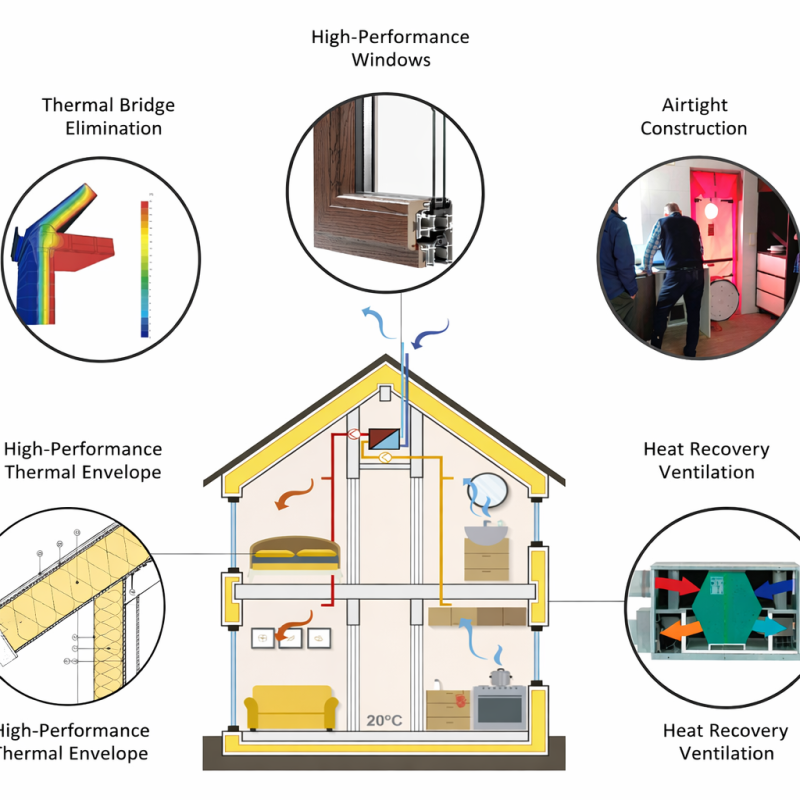
The main goal of a Passive House is to achieve exceptional indoor comfort while maintaining extremely low energy consumption. This leads to:
Passive House is based on design principles that:
High technical and construction standards ensure excellent thermal conditioning, keeping heat in during cold months and dissipating it in warm months.
Passive House buildings are aligned with Near Zero Energy Building (NZEB) standards, as defined by the European Directive 2010/31/EU on energy performance of buildings. This makes Passive House not a future concept, but a current standard for environmentally friendly, healthy, comfortable, and sustainable construction.
Passive House is gaining traction in Latin America as a viable model for climate-responsive, energy-efficient buildings, adaptable to diverse climates and construction practices.
The operation of a Passive House is based on strict energy-focused design, engineering, and construction requirements, grounded in the following key concepts:
The design of a Passive House relies on the careful combination and optimization of several fundamental aspects:
Compactness is defined as the ratio of the building envelope surface area to the enclosed volume.
The building’s orientation affects energy demand by influencing solar radiation and wind exposure on the envelope.
Solar radiation provides passive heating in winter, but can create overheating issues in summer. Proper solar shading allows you to:
Increasing exterior surface reflectivity also reduces absorbed solar radiation, lowering cooling demand in summer.
A well-designed continuous thermal insulation layer within the building envelope—following the “continuous insulation (CI)” principle—significantly improves overall thermal performance, especially in winter when the temperature differential between interior and exterior is greatest, reducing heat loss to the outside.
Depending on the climate, the goal is to optimize insulation thickness to reach the point of diminishing returns, where additional thickness provides only marginal gains in energy efficiency.
The common misconception that excessive insulation negatively impacts summer performance—by trapping heat absorbed במהלך the day—is addressed through complementary passive cooling strategies, including:
Thermal mass refers to the ability of a building material in direct contact with indoor air to absorb and store heat energy until it reaches equilibrium, at which point the heat flow reverses and energy is released back into the space.
From this perspective, thermal mass can be understood as an energy buffer, functioning similarly to a thermal battery. When properly designed and optimized, this “battery” can:
This process contributes to indoor temperature stability, improving occupant comfort and reducing overall heating and cooling loads.
However, thermal mass is not always beneficial. Its effectiveness depends on climate conditions, diurnal temperature swings, and building use patterns. In some cases—especially in consistently warm or humid climates—thermal mass can lead to undesirable heat retention if not properly managed.
Thermal bridges are linear or point-specific areas within the building envelope where heat flow is significantly higher than through the surrounding assemblies.
These conditions negatively impact overall energy performance and increase the risk of:
The Passive House standard emphasizes a continuous, high-performance thermal envelope, carefully designed to minimize or eliminate thermal bridging. This is achieved through proper detailing, alignment of insulation layers, and the use of thermal break materials at critical junctions.
The Passive House standard establishes strict performance requirements for windows, as they are typically the weakest component of the building envelope in terms of energy performance.
To address this, Passive House design incorporates high-performance glazing systems, including:
The glazing typically includes low-emissivity (low-E) coatings, which:
Windows are also selected based on a high Solar Heat Gain Coefficient (SHGC) when appropriate, allowing for:
This strategy is balanced with passive design measures, such as external shading devices, to prevent overheating and ensure optimal indoor comfort during summer months.
Controlled ventilation systems in Passive House design vary by climate and may include exhaust-only (single-flow) systems in mild climates or balanced ventilation systems (HRV/ERV) in more demanding climates.
These systems incorporate heat recovery (HRV) or energy recovery (ERV) to reclaim a significant portion of the energy from exhaust air when replacing stale indoor air with fresh outdoor air. This process helps pre-condition incoming air, reducing overall heating and cooling demand.
To maintain high energy efficiency, the Passive House standard typically targets an air exchange rate of approximately 0.3 air changes per hour (ACH) under normal operation (with higher rates possible during summer conditions).
Because a Passive House building features very high levels of thermal insulation, all construction joints must have minimal air leakage (infiltration).
Air infiltration represents unwanted and uncontrolled energy losses that are not managed by the ventilation system. It results in:
Airtightness is a key aspect of the Passive House standard, with a significant impact on overall energy efficiency. It ensures the proper operation and performance of balanced mechanical ventilation systems with heat recovery (HRV/ERV).
Beyond energy performance, uncontrolled air leakage can cause:
Airtightness is verified through a blower door test (pressurization test). This test uses a calibrated fan installed in an exterior door or window to create a pressure difference of 50 Pascals (Pa).
To meet the Passive House standard, the building envelope must achieve an airtightness level of:
Natural ventilation is a critical strategy for Passive House buildings in warm climates. During summer, nighttime natural ventilation (night flushing) is highly effective in dissipating the heat accumulated במהלך the day.
This approach is most effective in climates with significant diurnal temperature swings, where nighttime temperatures drop considerably compared to daytime highs.
Compliance with the Passive House standard is based on energy modeling using the PHPP (Passive House Planning Package) software.
Meeting the standard’s requirements is achieved through the optimization of the building’s energy balance—the relationship between heat gains and losses—using the PHPP calculation tool.
The operation of a Passive House is based on strict energy-focused design, engineering, and construction requirements, grounded in the following key concepts:
The design of a Passive House relies on the careful combination and optimization of several fundamental aspects:
Compactness is defined as the ratio of the building envelope surface area to the enclosed volume.
The building’s orientation affects energy demand by influencing solar radiation and wind exposure on the envelope.
Solar radiation provides passive heating in winter, but can create overheating issues in summer. Proper solar shading allows you to:
Increasing exterior surface reflectivity also reduces absorbed solar radiation, lowering cooling demand in summer.
A well-designed continuous thermal insulation layer within the building envelope—following the “continuous insulation (CI)” principle—significantly improves overall thermal performance, especially in winter when the temperature differential between interior and exterior is greatest, reducing heat loss to the outside.
Depending on the climate, the goal is to optimize insulation thickness to reach the point of diminishing returns, where additional thickness provides only marginal gains in energy efficiency.
The common misconception that excessive insulation negatively impacts summer performance—by trapping heat absorbed במהלך the day—is addressed through complementary passive cooling strategies, including:
Thermal mass refers to the ability of a building material in direct contact with indoor air to absorb and store heat energy until it reaches equilibrium, at which point the heat flow reverses and energy is released back into the space.
From this perspective, thermal mass can be understood as an energy buffer, functioning similarly to a thermal battery. When properly designed and optimized, this “battery” can:
This process contributes to indoor temperature stability, improving occupant comfort and reducing overall heating and cooling loads.
However, thermal mass is not always beneficial. Its effectiveness depends on climate conditions, diurnal temperature swings, and building use patterns. In some cases—especially in consistently warm or humid climates—thermal mass can lead to undesirable heat retention if not properly managed.
Thermal bridges are linear or point-specific areas within the building envelope where heat flow is significantly higher than through the surrounding assemblies.
These conditions negatively impact overall energy performance and increase the risk of:
The Passive House standard emphasizes a continuous, high-performance thermal envelope, carefully designed to minimize or eliminate thermal bridging. This is achieved through proper detailing, alignment of insulation layers, and the use of thermal break materials at critical junctions.
The Passive House standard establishes strict performance requirements for windows, as they are typically the weakest component of the building envelope in terms of energy performance.
To address this, Passive House design incorporates high-performance glazing systems, including:
The glazing typically includes low-emissivity (low-E) coatings, which:
Windows are also selected based on a high Solar Heat Gain Coefficient (SHGC) when appropriate, allowing for:
This strategy is balanced with passive design measures, such as external shading devices, to prevent overheating and ensure optimal indoor comfort during summer months.
Controlled ventilation systems in Passive House design vary by climate and may include exhaust-only (single-flow) systems in mild climates or balanced ventilation systems (HRV/ERV) in more demanding climates.
These systems incorporate heat recovery (HRV) or energy recovery (ERV) to reclaim a significant portion of the energy from exhaust air when replacing stale indoor air with fresh outdoor air. This process helps pre-condition incoming air, reducing overall heating and cooling demand.
To maintain high energy efficiency, the Passive House standard typically targets an air exchange rate of approximately 0.3 air changes per hour (ACH) under normal operation (with higher rates possible during summer conditions).
Because a Passive House building features very high levels of thermal insulation, all construction joints must have minimal air leakage (infiltration).
Air infiltration represents unwanted and uncontrolled energy losses that are not managed by the ventilation system. It results in:
Airtightness is a key aspect of the Passive House standard, with a significant impact on overall energy efficiency. It ensures the proper operation and performance of balanced mechanical ventilation systems with heat recovery (HRV/ERV).
Beyond energy performance, uncontrolled air leakage can cause:
Airtightness is verified through a blower door test (pressurization test). This test uses a calibrated fan installed in an exterior door or window to create a pressure difference of 50 Pascals (Pa).
To meet the Passive House standard, the building envelope must achieve an airtightness level of:
Natural ventilation is a critical strategy for Passive House buildings in warm climates. During summer, nighttime natural ventilation (night flushing) is highly effective in dissipating the heat accumulated במהלך the day.
This approach is most effective in climates with significant diurnal temperature swings, where nighttime temperatures drop considerably compared to daytime highs.
Compliance with the Passive House standard is based on energy modeling using the PHPP (Passive House Planning Package) software.
Meeting the standard’s requirements is achieved through the optimization of the building’s energy balance—the relationship between heat gains and losses—using the PHPP calculation tool.

Get expert answers to all your construction project questions. Speak with our team today and ensure your project stays on schedule, on budget, and to the highest quality standards.
We are ready to answer right now! Sign up for a free consultation.
I consent to the processing of personal data and agree with the user agreement and privacy policy